Fort Lauderdale regulates land use through its Unified Land Development Regulations (ULDR) — a use-and-district-based code distinct from Miami 21's form-based transect system. If you are buying, building, or repositioning property in Broward County's largest city, understanding how the ULDR structures approvals will save you time and money before you spend a dollar on design.
How Fort Lauderdale's ULDR Is Organized
The Fort Lauderdale ULDR is codified at §§ 47-1 et seq. and currently runs through Supplement 57 (updated February 2026). It uses conventional zoning districts — residential, commercial, industrial, and mixed-use — rather than a transect approach. Each district carries a permitted-use list, setback tables, height limits, and parking ratios.
Key districts to know:
- RAC-CC (Regional Activity Center — City Center): The downtown core overlay. It allows the highest densities and building heights in the city. Projects within the RAC-CC are subject to elevated design standards and, for larger developments, an urban design review component.
- B-1 through B-3 (Business/Commercial): Standard commercial corridors; B-3 allows the broadest range of commercial uses.
- RMM and RMH (Residential Multi-Family): The medium- and high-density multifamily districts; most infill apartment projects fall here.
For comparison, Broward County's Land Development Code (Chapter 5, Article IX) governs unincorporated areas using a parallel use-based structure. Understanding both is essential for projects that straddle the municipal boundary.
The Approval Pathway: DRC, Board, and Commission
For most non-administrative development applications, Fort Lauderdale uses a three-stage process:
Stage 1 — Pre-application meeting. Schedule with Development Services before you file. Staff will confirm the applicable district, overlay requirements, and any waivers or variances your project may require.
Stage 2 — Development Review Committee (DRC). The DRC is the technical review body. It coordinates input from Engineering, Public Works, Urban Design, and other departments. Site plan applications, rezonings, and conditional use permits all pass through DRC before any public hearing.
Stage 3 — Planning and Zoning Board or City Commission. Legislative changes (rezonings, future land use amendments) go to the City Commission. Quasi-judicial matters (variances, conditional uses) typically go to the Planning and Zoning Board first, then to Commission if appealed.
Timelines vary: a straightforward site plan can clear DRC in 30–60 days. A rezoning involving a public hearing can run 90–180 days depending on board scheduling and completeness of the initial submittal.
Common Approval Types and What They Require
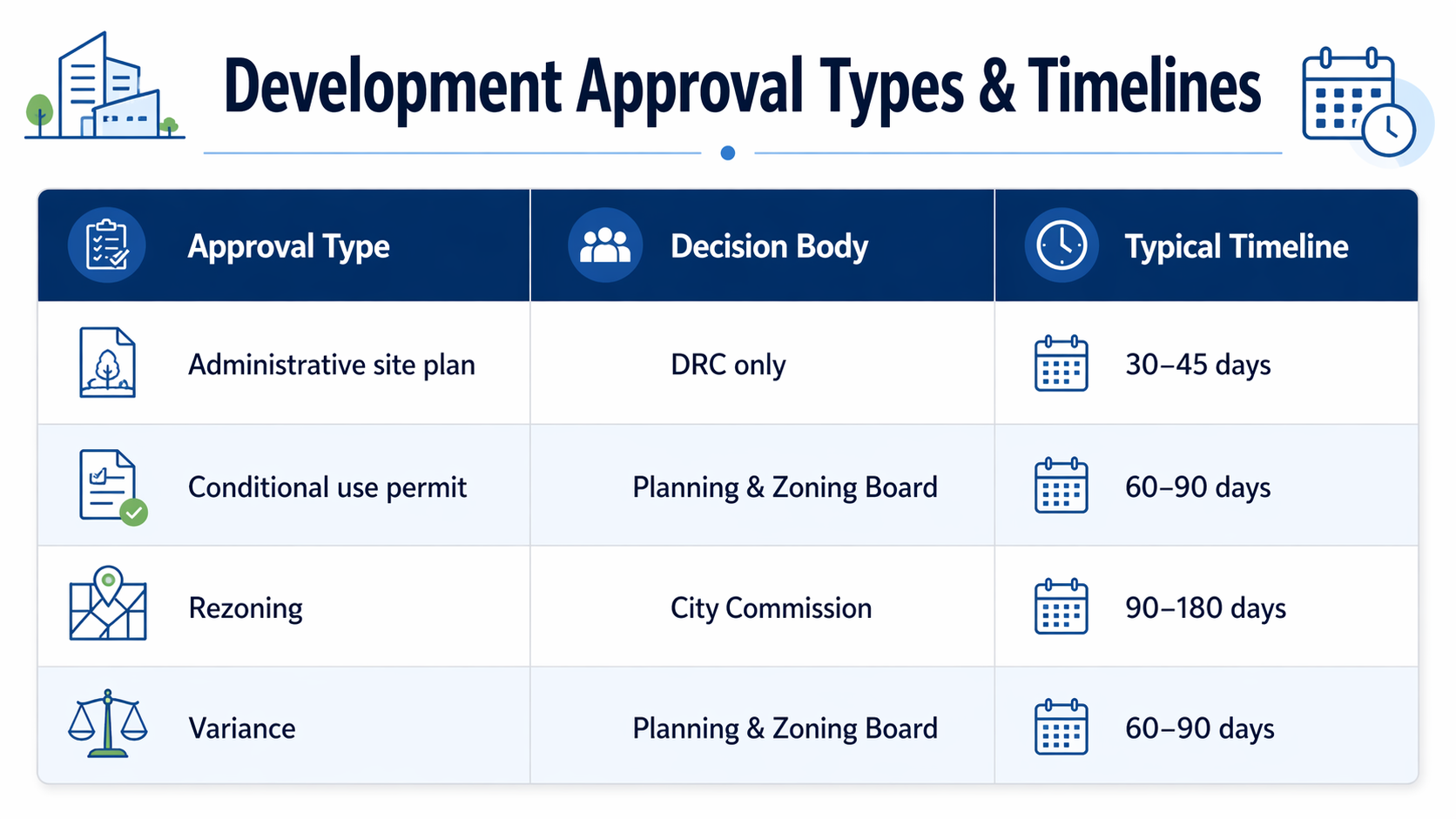
A variance — a deviation from code requirements based on hardship — requires a different legal standard than a waiver or conditional use permit. Conflating these is one of the most common mistakes in early project planning. The ULDR's standards for each approval type are specific; a submittal that fails to meet the correct legal threshold will be denied.
Flood and Environmental Compliance
No Fort Lauderdale project escapes flood compliance. Broward County's FEMA FIRMs were updated on July 31, 2024. Broward imposes local flood standards above the federal NFIP minimums: finished floor elevations must satisfy the highest of the 2014 FIRMs, the July 2024 FIRMs, or the county's own 100-year, 3-day flood elevation map. This affects pad elevations, parking structure design, and mechanical room placement — all of which need to be coordinated before construction documents are finalized. The SFWMD Environmental Resource Permit process runs parallel for any project that disturbs more than 10 acres or involves drainage.
Ready to map your Fort Lauderdale project against the ULDR before you commit to a site? Schedule a discovery call to get a forensic zoning analysis — district classification, overlay exposure, and approval pathway — in writing before you are under contract. Contact us today for a free consultation!
FAQ
Q: Does Fort Lauderdale use Miami 21's transect zones?
A: No. Fort Lauderdale uses the ULDR — a conventional use-and-district code, not a form-based transect system. Miami 21 applies only within the City of Miami. Fort Lauderdale's districts (B-1, B-2, RAC-CC, RMH, etc.) carry their own permitted-use lists and development standards under the Fort Lauderdale ULDR, Supplement 57.
Q: What is the RAC-CC and why does it matter for downtown Fort Lauderdale projects?
A: The RAC-CC (Regional Activity Center — City Center) is the downtown overlay district permitting the highest densities and building heights in Fort Lauderdale. Development within it is subject to urban design review standards and, for larger projects, an additional design component before DRC. If your site falls in RAC-CC, budget for that review step.
Q: How long does a rezoning take in Fort Lauderdale?
A: A typical rezoning runs 90–180 days from a complete application to City Commission approval. That timeline assumes no public opposition, no deficiency letters requiring major resubmittals, and adequate board scheduling availability. A pre-application meeting with Development Services helps front-load issue identification and reduce delays.
Q: Does Broward County's flood code apply inside Fort Lauderdale?
A: Broward County's updated FEMA FIRMs (effective July 31, 2024) set the baseline, and Broward's local flood standards — which require the highest of three elevation benchmarks — apply countywide, including within Fort Lauderdale. The Broward County Land Development Code imposes these minimums; individual municipalities may add further requirements.
Q: Do I need a pre-application meeting before filing with the DRC?
A: It is strongly recommended and, for larger projects, effectively required. Pre-application meetings with Fort Lauderdale Development Services identify overlay requirements, missing submittal items, and potential variance needs before you invest in full construction documents. A single pre-application meeting can prevent multiple rounds of DRC deficiency letters.