Navigating the Miami21 Code can feel like trying to solve a puzzle where the pieces are constantly moving. For developers, architects, and property owners, the “red tape” of the City of Miami’s planning department often represents the single greatest risk to a project’s ROI and timeline.
Schedule FREE ConsultationMiami land use entitlements are the formal approvals required to legally develop, modify, or intensify the use of a property. These approvals are governed primarily by the Miami21 Zoning Ordinance, Miami-Dade County regulations, and individual municipal procedures.
Entitlements may include zoning variances, conditional use permits, rezoning applications, site plan approvals, plat actions, special exceptions, warrants, and waivers. Each one has a defined legal and technical pathway.
The most common mistake property owners make is treating zoning as a single step. In reality, zoning entitlements are a sequence of approvals, each dependent on the last. Missing one requirement stalls the entire project.
This is why understanding the roadmap matters more than understanding the code language itself.

This is the most misunderstood decision in Miami development.
Many property owners assume zoning automatically requires a lawyer. In practice, most zoning cases in Miami are administrative rather than adversarial. They require technical coordination, planning, analysis, and process management rather than litigation.
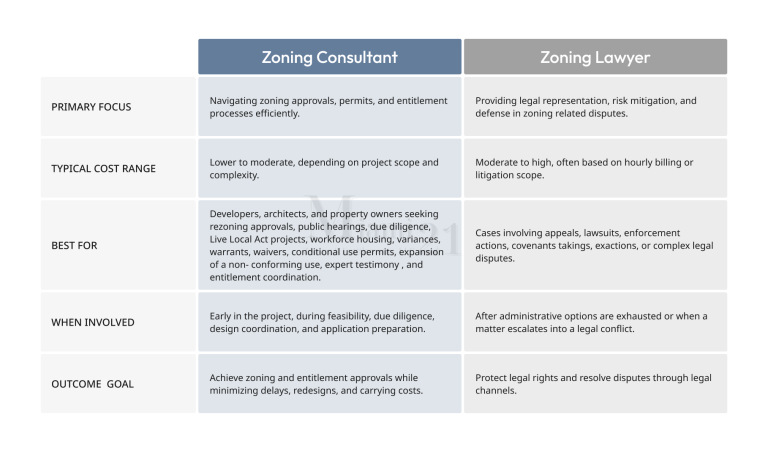
A zoning consultant focuses on navigating the system. A zoning lawyer focuses on defending you if the system becomes a legal dispute.
For most projects involving zoning entitlements in Miami, a zoning consultant is the more efficient and cost-effective option. This includes cases such as:
A zoning consultant manages the technical aspects of your case. This includes zoning analysis, coordinating architects and engineers, preparing findings of fact, managing submittals, and working directly with planning staff. The focus is on approvals, timelines, and feasibility.
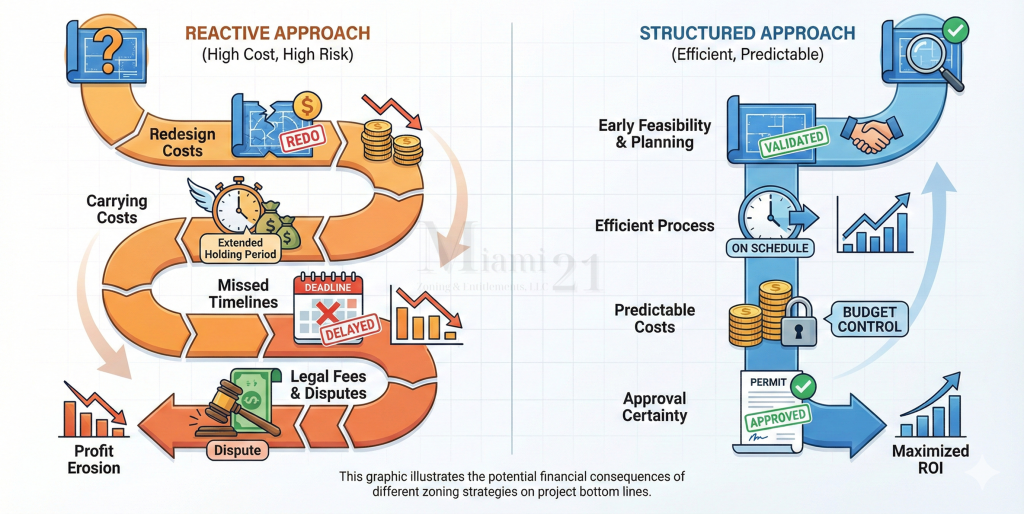
This approach is especially valuable for developers who care about ROI, carrying costs, and schedule certainty.
A zoning lawyer becomes necessary when there is active litigation, appeals, enforcement actions, or disputes that rise beyond administrative review. Examples include:
In short, if your case is about compliance and approvals, a zoning consultant in Miami is usually the right first call. If it becomes a legal fight, legal counsel can be layered in strategically.
Many successful projects use both, but not at the same time or at the same cost level.
Below is the five-stage process that governs nearly every successful zoning approval in Miami. Skipping a stage or rushing one usually leads to delays later.

Every successful project begins with a zoning analysis report, often called a ZAR. This report evaluates the property under the Miami21 zoning code to determine what is legally possible.
Key elements reviewed include:
The goal at this stage is to identify the highest and best use of the property before money is committed to design. Many developers discover too late that their proposed program exceeds the allowable FLR or conflicts with use restrictions.
Before any formal application is filed, experienced teams meet with the City of Miami planning staff. These pre-submittal meetings are not optional if you want speed.
During this stage, potential issues are flagged early, such as:
This step allows adjustments before drawings are finalized, saving weeks or months of revisions later. Planning staff feedback at this stage is informal but extremely influential.
Before any formal application is filed, experienced teams meet with the City of Miami planning and zoning staff. These pre-submittal meetings are not optional if you want speed.
During this stage, potential issues are flagged early, such as:
This step allows adjustments before drawings are finalized, saving weeks or months of revisions later. Planning staff feedback at this stage is informal but extremely influential.
Major entitlements, such as a rezoning or exception, require a public hearing before the City Commission.
Success here is dependent on:
Boards in Miami are less persuaded by emotional arguments and more by consistency with the Miami21 code and planning intent.
A zoning consultant typically leads this stage by presenting the project, responding to board questions, and ensuring conditions are clearly understood.
Once the hearing is won, the work isn’t over. There is clearing post-approval conditions and “red-line” corrections.
Post approval conditions often include:
Proper post approval management ensures the entitlement translates into permits and construction without interruption.
To win a project in this jurisdiction, you must master the specific nuances of the Miami21 Code:

Developers who follow this roadmap consistently see:
The biggest savings come from avoiding unnecessary legal escalation and addressing zoning issues before they become violations.
Zoning is not red tape when handled correctly. It is a system with rules, incentives, and predictable outcomes.
The best time to start a zoning analysis is before acquisition or design finalization. The second-best time is now.
Zoning is abstract and often intimidating, but it doesn’t have to be. We provide the zoning help in Miami that developers need to turn a site into a success.
Ready to see what’s possible?